
Mining Pool Fees and the Real Cost of Variance
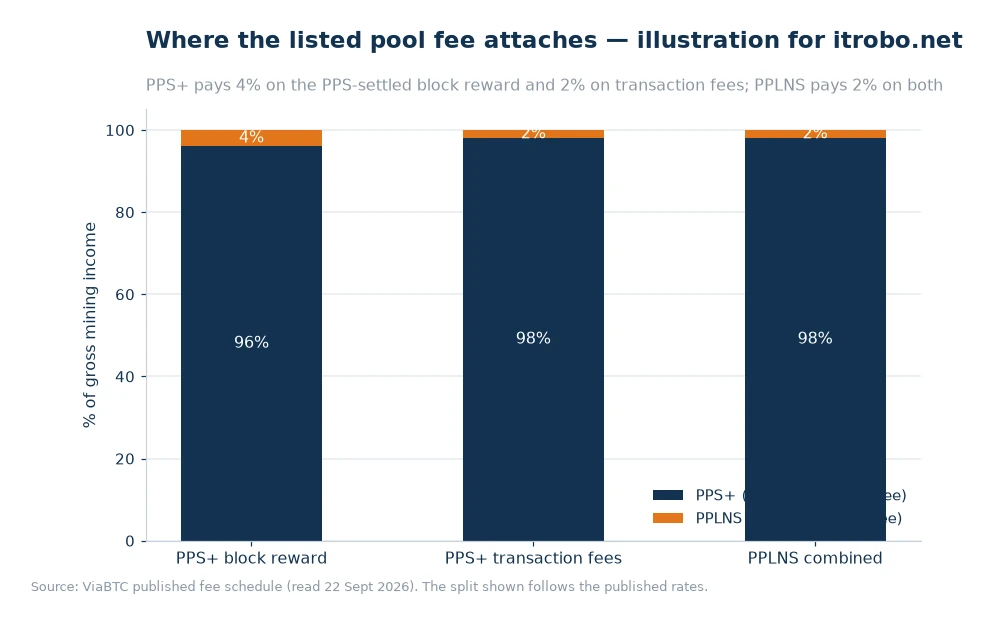
Variance has a price, and the fee schedule is where you pay it. At 1 PH/s, one hour of stopped hashrate is about $1.68 of forgone gross income, and a bad luck stretch on a merged PPLNS rate lands on your payout rather than the operator's. The difference between a listed 4% and a listed 2% on the block-reward component is $24.23 a month at that same 1 PH/s — roughly the value of 14 hours of downtime.
Key takeaways
- One hour of downtime at 1 PH/s costs about $1.68; a full day is about $40.39 gross or $38.77 after the listed 4% fee.
- The gap between the listed 4% and 2% rates on the block-reward component is $24.23 a month at 1 PH/s, about 14 hours of stopped hashrate.
- PPS+ settles hourly at current difficulty, so pool luck and orphaned blocks do not shrink the block-reward component — that certainty is what the higher rate buys.
- PPLNS distributes after 6 confirmations over the last 5 difficulty rounds at a listed 2%, which lowers the rate and returns the variance to the miner.
What variance actually is
Three things move a miner's income that are not the miner's hashrate or the coin's price. The first is pool luck: whether the pool found more or fewer blocks than its share of network hashrate implied during the period that sets your payout. The second is the orphaned block, found and then discarded by the network, whose reward never reaches anyone. The third is downtime, which is not random at all but behaves like variance in the monthly total because its timing is unpredictable.
Contract terms decide which of the first two you carry. Under PPS+ the block-reward component is settled per accepted share at current difficulty and paid every hour, so a twelve-hour stretch without a block changes nothing about what you are owed. Under PPLNS both components are merged into one distribution, weighted over the last five difficulty rounds and released after six confirmations, so the pool's luck inside that window is a direct input to your payout.
Putting a number on each source
Duration converts variance into money. At current difficulty, 1 PH/s produces about $0.0404 per TH/s per day, which is $1.68 an hour across a thousand terahashes, $40.39 a day and $1,211.68 across 30 days. Any interruption, whether it is a failed board, a power event or a network fault, is billed at that hourly rate.
Luck is harder to price in advance but easy to price after the fact. If a pool with 0.1% of network hashrate is expected to find 0.144 blocks a day, then a day with none is a variance event, and under PPLNS it is your variance event. The published rate difference is the explicit price of transferring it: at 1 PH/s a month, a 4% line on the block reward and a 2% line differ by $24.23, which buys roughly fourteen hours of outage equivalence — with no equipment to fix.
| Source | How it shows up | Cost or value at 1 PH/s | Who carries it |
|---|---|---|---|
| Pool luck | Blocks found versus blocks expected over the payout window | Swings the payout itself, not a fixed amount | Pool under PPS+, miner under PPLNS |
| Orphaned block | A found block the network discards | Loses the participants' share of one block | Pool under PPS+ |
| Downtime | Hours of hashrate not delivered | About $1.68 per hour, $38.77 net per day | Miner, whichever method is used |
| Transfer fee | Difference between the listed 4% and 2% block-reward rates | About $24.23 a month | Paid by the miner who wants the certainty |
Variance that arrives in a second coin
Single-coin arithmetic understates what a multi-coin fleet carries. In a merged-mining setup the DOGE produced alongside LTC arrives as a separate output, so its value belongs on its own line: LTC pays 6.25 coins per 2.5-minute block, about 3,600 coins network-wide a day, which is roughly $0.0805 per GH/s per day at a price of $60.68, and the DOGE on top moves with a different market. Two coins mean two price curves feeding one daily number.
Kaspa sits at the other extreme. The network issues about 1,885,832 KAS a day, roughly $80,768 at a price of $0.042829, and blocks arrive about ten times a second, so reported hashrate and earnings move within minutes rather than within hours. Whatever the coin, the listed fee applies to the settled output of that coin, and the variance you carry is the sum of its price path, its difficulty path and your own uptime.
Worked example: a month at 1 PH/s
Start with gross output. One PH/s is 1000 TH/s, and 1000 multiplied by $0.0404 gives $40.39 a day, or $1,211.68 over 30 days — that is 0.014206 BTC at $85,294. On the PPS+ line the listed 4% applies to the block-reward component and costs $48.47 over the month, leaving $1,163.21. On a 2% line the same component would cost $24.23, leaving $1,187.45.
The $24.23 gap is the insurance premium for the month. Now compare it with downtime, which is the variance you control: at $1.68 an hour, 24.23 divided by 1.68 is about 14.4 hours. In other words, an operator who avoids fourteen hours of avoidable outage in the month has paid for the more expensive method out of uptime alone, without touching luck at all.
Choosing which variance to keep
The choice is not between a cheap method and an expensive one, it is between two distributions. A farm that pays power and hosting on fixed dates is funded from a curve it can predict, so hourly settlement against current difficulty removes a variable it did not need. An operator with reserves, long time horizons and plenty of uptime discipline can take the lower rate and accept that a quiet week is part of the average.
Both decisions rest on numbers the operator publishes. The ViaBTC Pool Fees page states the listed 4% and 2% rates beside the components they apply to, and describes the settlement rule for each method, which is enough to model the premium per PH/s exactly. Run your own hashrate through the Profit Calculator to see the daily figure, then subtract the fee line on the component you intend to pay it on.
Frequently asked questions
Is the higher fee worth it at small hashrate?
In absolute terms it is small: at 100 TH/s the difference between the two block-reward rates is about $2.42 a month. What matters more at that size is whether the payout threshold is low enough for credits to leave the account.
Can downtime be treated like luck?
No. Luck averages out over enough windows; downtime is a permanent subtraction. An hour lost at 1 PH/s is $1.68 that never returns, while an unlucky window on PPLNS is recovered in a later one.
Does the fee change what I earn on average?
It changes the mean by the amount charged and changes the spread by which method you choose. Your share of network hashrate still sets the ceiling; the fee decides how much of it you keep.
Where do I see whether my own variance is normal?
Compare realised output with the expected figure for your hashrate over the same period. A sustained shortfall points to a hashrate or reject-rate problem rather than to luck.
Price the premium, then decide
Compute your hourly output, multiply it by the hours of outage you suffered last month, and compare that number with the extra fee the settled method charges. If uptime discipline already costs more than the premium, the higher listed rate is the cheaper of the two arrangements; if your fleet runs clean and you can wait for block confirmations, the lower rate is available. Whichever you pick, track both numbers monthly and revisit the choice when the estimated 1.90% difficulty adjustment lands.
Data and sources: the ViaBTC published fee schedule, including the listed 4% and 2% rates and the settlement rules for PPS+ and PPLNS[1], and the pool statistics pages used to check hashrate and difficulty[2]. Inputs read 22 Sept 2026: difficulty 132.76 T, network hashrate near 950.3 EH/s, a 3.125 BTC subsidy per block and a BTC price of $85,294. Every number above is derived from those inputs and shifts when they do.